Peer-reviewed2017
Attention Is All You Need
Introduced the Transformer, a sequence model built entirely on self-attention that removed the sequential recurrence of RNNs and enabled full parallelization of training across positions.
An evidence-led archive
A map of the research behind Transformers, scaling, alignment, reasoning, multimodality, retrieval, and agents — organised by how each work depends on the others, not by fame or citation count.
Every record links a primary source and has been editorially reviewed. Citation counts are estimates, shown with their retrieval date and never used to rank. See the methodology.
Introduced the Transformer, a sequence model built entirely on self-attention that removed the sequential recurrence of RNNs and enabled full parallelization of training across positions.
Showed that scaling an autoregressive language model to 175B parameters yields in-context few-shot learning, where tasks are specified through examples in the prompt rather than by fine-tuning weights.
Corrected the earlier scaling prescription by showing parameters and training tokens should be scaled in roughly equal proportion, revealing that then-current large models were badly undertrained for their compute budgets.
Showed that prompting a large model to emit intermediate reasoning steps before its answer unlocks multi-step reasoning that direct-answer prompting fails at, without any fine-tuning.
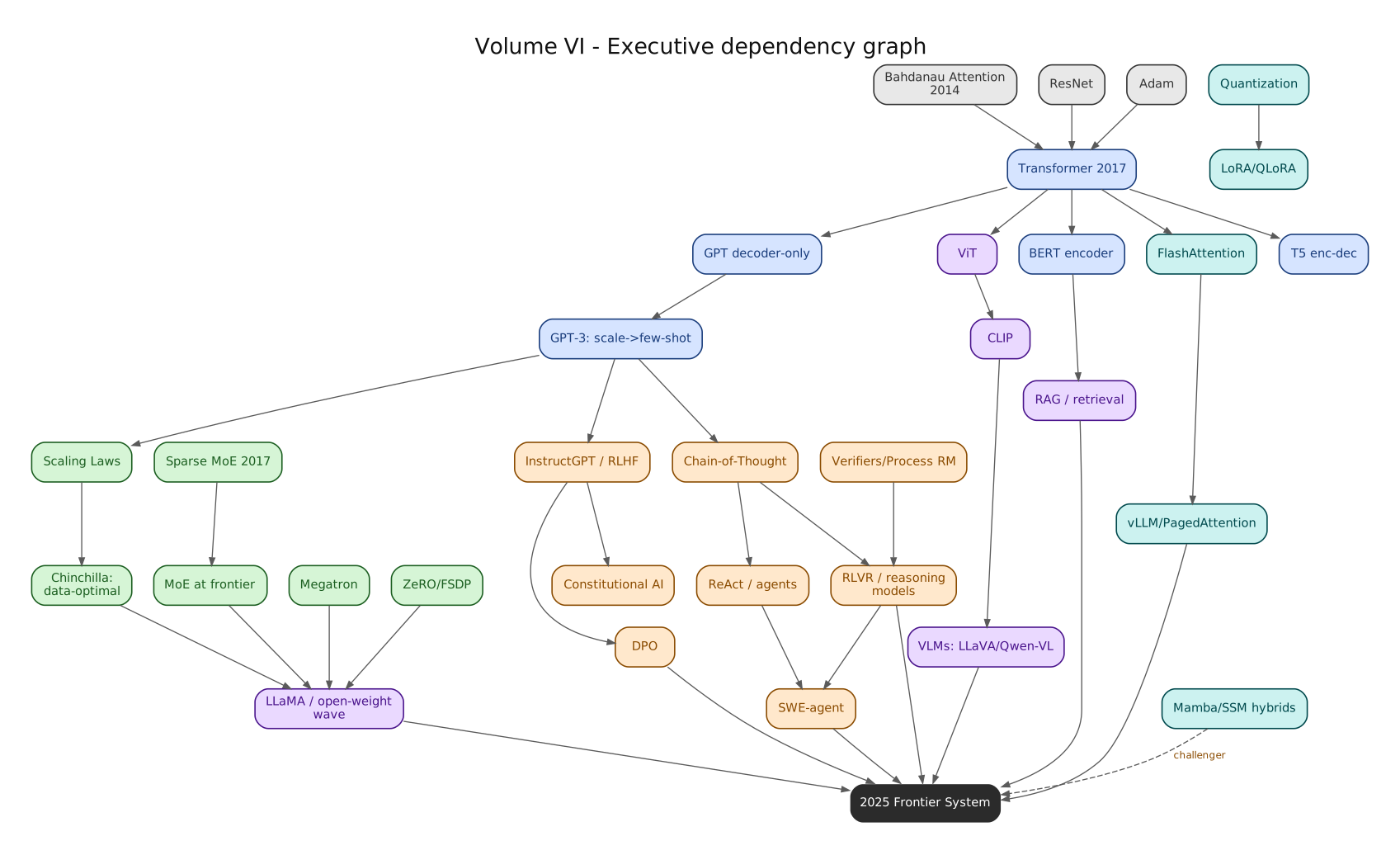
Modern AI was not created by one paper or one lab. It emerged from a network of architectural breakthroughs, training methods, data practices, infrastructure, alignment techniques, and open implementations. This is its spine.
Introduced the backpropagation algorithm for training multi-layer neural networks by propagating output error backward through the network to compute weight gradients, removing the barrier that networks with hidden layers had no practical learning rule.
Proposed learning a distributed vector representation for each word jointly with a neural network that predicts the next word, addressing the curse of dimensionality that made count-based n-gram language models generalize poorly to unseen word combinations.
Introduced the continuous bag-of-words and skip-gram models (Word2Vec), simple shallow architectures that learn word vectors from raw text far more cheaply than prior neural language models, removing the compute cost that had limited embedding training to small corpora.
GloVe introduced a word-embedding method that learns vectors by factorizing a corpus-wide word co-occurrence matrix, solving the problem of combining global corpus statistics with the useful linear structure of local-context methods.
Introduced a general end-to-end LSTM encoder-decoder that maps an input sequence to a fixed-length vector and decodes it into an output sequence, removing the need for fixed-alignment, feature-engineered pipelines in sequence transduction.